What eighteenth-century Neapolitan bass lines and high-school algebra taught me about recognition, and about having too many interests
A Word I Didn’t Know
The first time I heard the word partimento, it came from a musician who devotes himself to early music, and it came in passing, the way specialists mention things they assume everyone already knows. I didn’t know it. I asked. And the answer stayed with me much longer than the conversation did.
A partimento, roughly, is a bass line: sometimes with a few figures written above it, often with nothing at all. Students at the eighteenth-century Neapolitan conservatories worked through hundreds of them, turning each one, at the keyboard, into complete music. They weren’t expected to invent from scratch. They had rules to guide them: how to harmonize each step of the scale, how to handle a cadence, what to do when the bass rises or falls by a given interval. They applied those rules exercise after exercise, until the right response became automatic. Alongside the partimenti ran a shared vocabulary of stock musical patterns that any trained musician of the time could recognize at a glance. Two centuries later, the musicologist Robert Gjerdingen gave them names, borrowing some from older sources and coining the rest: the galant schemata.
Rules to learn. Exercises to repeat. Patterns to recognize at a glance. I knew that method. I just didn’t know it had anything to do with music.
For more than twenty years, I taught mathematics and physics to teenagers. Every one of them, sooner or later, meets the same small set of formulas: the square of a binomial, the difference of two squares, a handful of others. In Italy we call them prodotti notevoli, literally “notable products.” They get memorized, drilled, and then used everywhere, often without students noticing they’re still using them.
So the first thing I felt, reading about partimenti, wasn’t the thrill of discovering something new. It was recognition. Which, as it turns out, is exactly what the whole method is about.
Bass Lines, Rules, and a Shared Vocabulary
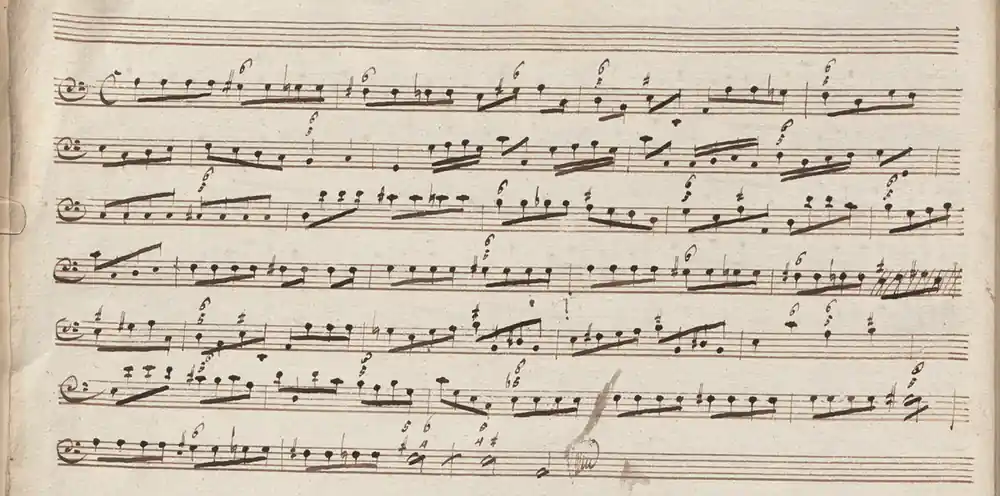
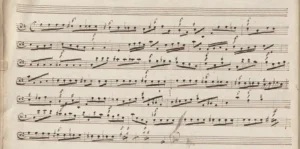
This is what a partimento looks like: a single line, in the bass clef, with a few numbers written above some of the notes. That’s all the student was given. Everything else (the harmony, the upper voices, the melody) had to come from the student’s own hands, at the keyboard.
This one comes from the first book of partimenti by Fedele Fenaroli (1730–1818), who studied at the Conservatorio di Santa Maria di Loreto in Naples under Francesco Durante and Leonardo Leo, and went on to teach there for decades. His students included Domenico Cimarosa and Saverio Mercadante. Naples at the time had four conservatories, originally charitable institutions that took in orphans and poor boys (the name comes from conservare, to keep, to shelter) and trained them in music. Out of them came a good part of the composers who filled the opera houses and chapels of eighteenth-century Europe. Fenaroli’s partimenti outlived their author by a long way: they were printed, reprinted, translated into French, and used in conservatories well into the nineteenth century.
Before touching a single exercise, though, a student had to learn the rules. The core of them fits on a couple of pages. There are three standard cadences, the ways a phrase comes to rest. And there is the rule of the octave, which assigns every note of the scale, going up and going down, a default chord. Then come the typical movements of the bass: what to do when it rises a step, falls a third, leaps a fourth. None of this is composition yet. It’s closer to a table of formulas: a small set of answers to a small set of recurring questions, learned until they no longer need to be looked up.
Only then came the partimenti themselves, in graded sequence. The first ones in Fenaroli’s book are simple enough to be realized with plain chords in the right hand. Later ones introduce dissonances, imitation, and more elaborate textures. The most advanced partimenti were fugues in embryo: a bass that the student had to grow, voice by voice, into a complete fugue.
The galant schemata belong to the same world but answer a different question. A partimento is an exercise; a schema is a pattern. It’s a short, stock progression, a particular bass motion paired with a particular melodic line, that composers of the time used so often that listeners recognized it the way we recognize a familiar turn of phrase. Gjerdingen reconstructed these patterns from the repertoire itself and from the teaching materials of the period, partimenti included, and gave them names.
Here is one of them, the Romanesca.
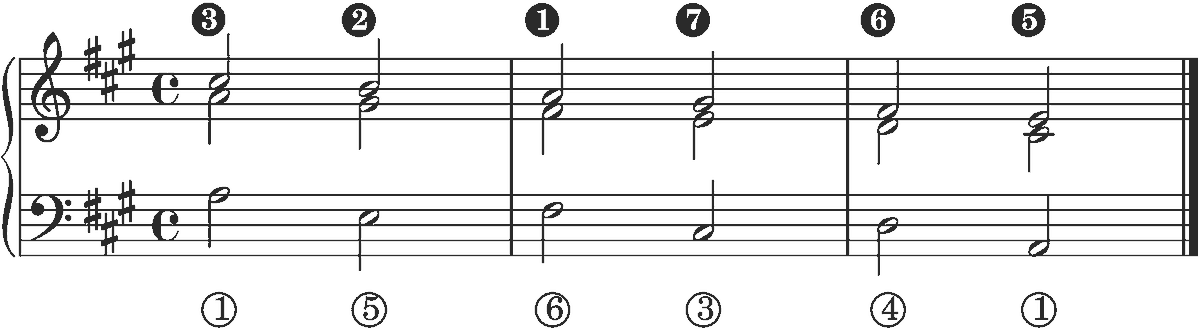
The black numbers above the staff are the degrees of the scale in the melody; the white ones below are the degrees in the bass. The melody walks down the scale, 3–2–1–7–6–5, while the bass leaps: 1–5–6–3–4–1. If you know Pachelbel’s Canon, you’ve heard something very close to this bass before.
Now the same schema again.
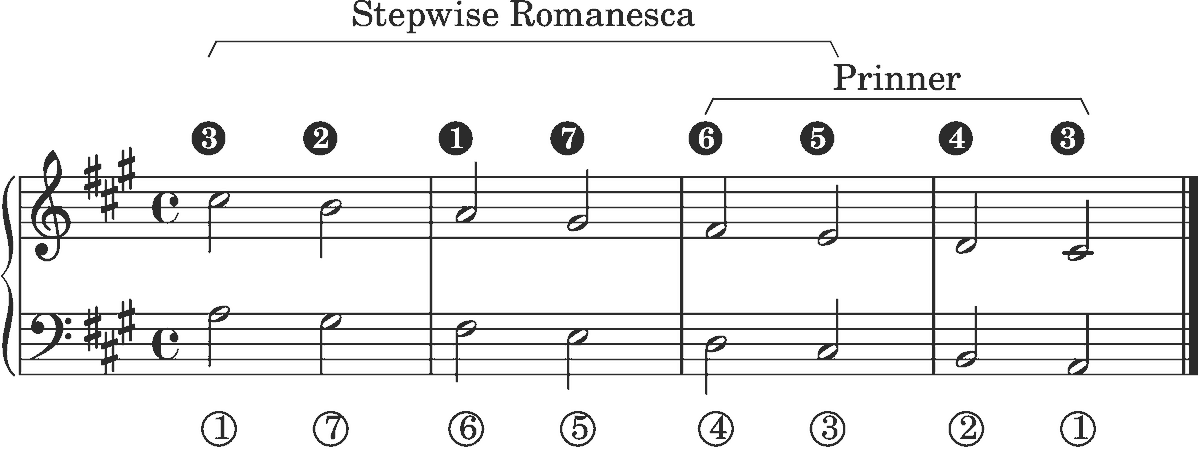
The melody starts the same way, but the bass no longer leaps. It descends by step: 1–7–6–5–4–3. Two different surfaces, one pattern underneath. And look at what happens at the end. The last two moves of the Romanesca, 6–5 in the melody over 4–3 in the bass, are also the first two moves of another schema, the Prinner, which carries the music down to rest: 6–5–4–3 in the melody over 4–3–2–1 in the bass. One schema doesn’t simply end before the next begins. They overlap, and the tail of one becomes the head of the other.
What matters here is how they were used. A galant movement wasn’t built by expanding a single idea. It was built by chaining schemata one after another, the way we build sentences out of phrases we already know by heart. That’s how a teenager trained in Naples could write, or improvise, music that sounded fluent and complete. He wasn’t inventing the language as he went. He had internalized it so deeply that he no longer had to think about the words, only about what he wanted to say.
A Formula You Stop Seeing
In Italy, students meet these formulas at around fourteen, in their first year of secondary school. Take one of the simplest:
Read from right to left, it’s a multiplication: multiply (A + B) by (A − B) and the middle terms cancel, leaving A² − B². Read from left to right, it’s a factorization: whenever you see a difference of two squares, you can break it into a product. The two directions aren’t equally hard. Multiplying out is mechanical. Factoring requires you to recognize the pattern first, and nobody is going to tell you it’s there.
The key is that A and B can be anything:
It even works with plain numbers, which makes it a nice trick for mental arithmetic:
And sometimes the pattern hides inside itself:
The first step only works if you see x⁴ as (x²)² and 16 as 4². The second step is the same formula again, applied to one of its own results.
So what a student actually learns isn’t the formula. It’s the shape: something squared, minus something else squared. Whether training that kind of recognition makes people better at abstraction in general is an open question, and I don’t want to claim more than I know. But I’ve watched it happen, again and again, in one direction: the moment a student stops seeing letters and starts seeing shapes, mathematics becomes a different subject.
The payoff comes later, because the shape keeps coming back, often in places where nobody announces it:
- Algebraic fractions: (x² − 9)/(x − 3) simplifies to x + 3.
- Limits: the same fraction, as x approaches 3, tends to 6. It’s the same simplification, but now it’s called calculus.
- Integrals: 1/(x² − 1) splits into ½ · [1/(x − 1) − 1/(x + 1)], and each piece is easy to integrate.
- Complex numbers: (a + ib)(a − ib) = a² + b². It’s the same formula with B = ib, and it’s how you get rid of an imaginary number in a denominator.
- Matrices: here the formula breaks. (A + B)(A − B) = A² − AB + BA − B², which equals A² − B² only if AB = BA, and with matrices it usually doesn’t. The shape comes with conditions, and knowing when it doesn’t apply is part of knowing it.
A handful of formulas, learned at fourteen, still quietly at work years later, in subjects that have different names and different teachers. If you’ve just been looking at a Romanesca turning into a Prinner, this should sound familiar.
Seeing the Shape
Put the two side by side and the parallel is hard to miss.
In both cases, the student starts with a small repertoire: a handful of cadences and the rule of the octave in Naples, a handful of special products in an Italian classroom. In both cases, the repertoire is learned by heart and drilled until it no longer needs to be looked up. And in both cases, the drilling isn’t the goal. It’s what makes the next step possible.
The next step is recognition. A partimento doesn’t say which rule applies. There’s no label under the bass saying “stepwise descent from the tonic: harmonize it like this.” The student has to see it. An algebraic expression works the same way: nothing in x⁴ − 16 announces that it’s a difference of two squares. That’s why factoring is harder than multiplying out, and why realizing a partimento is harder than reciting the rule of the octave. The knowledge is the same. What changes is whether you’re told when to use it.
Then comes disguise. The two Romanescas we saw earlier share a melody, but one bass leaps and the other walks. A student who only knows one version will miss the other. x⁴ − 16 is a difference of two squares only if you’re willing to see x⁴ as (x²)², to let A stand for something that isn’t a single letter. In both cases, the pattern is defined by its structure, not its surface, and learning it means learning to ignore the surface.
Then chaining. In the second example, the tail of the Romanesca became the head of the Prinner. In x⁴ − 16, the result of the first factorization, x² − 4, became the input of the second. And in a limit problem, factoring is rarely the whole story: it’s one move in a sequence, the one that clears the way for the next. Neither a galant movement nor a calculus exercise is built from a single pattern. Both are built from patterns linked together, where the end of one prepares the beginning of the next.
Finally, conditions. The rule of the octave doesn’t assign one fixed chord to each note of the scale: some notes get a different chord depending on whether the bass is rising or falling. The difference of squares doesn’t survive in a world where AB and BA aren’t equal. A pattern known properly includes knowing where it stops working.
None of this is a coincidence of vocabulary. Cognitive psychologists have a name for what’s happening: chunking. In a famous 1973 study, William Chase and Herbert Simon showed that chess masters could reconstruct a position from a real game after a few seconds, far better than beginners, but lost most of that advantage when the pieces were placed at random. The masters weren’t seeing more pieces. They were seeing fewer, larger units: configurations they had met thousands of times. Gjerdingen draws on exactly this kind of research in his work on the schemata. A Neapolitan boy looking at a bass line, a student looking at a polynomial, a chess master looking at a board: all three are doing the same thing. They’re not reading symbol by symbol. They’re recognizing shapes.
I want to be careful here. Mathematics and music aren’t the same thing, and I’m not claiming they are. A proof and a sonata answer to very different demands. What I’m pointing at is narrower: the way the learning is structured. Two traditions, centuries and disciplines apart, found the same path: a small vocabulary, drilled until it disappears from view, so that attention can move up a level.
Which leaves the hardest part. Knowing a pattern is one thing. Recognizing it when it shows up somewhere you didn’t expect it is another. And that, in my experience, is exactly where students get stuck.
Watertight Compartments
I could tell a hundred versions of this story. Here’s one.
We had just finished the square of a binomial and its reverse: recognizing a perfect square and factoring it back.
The class had worked through the exercises, and they could do it. The next day the lesson had a new title: algebraic fractions, fractions whose numerator and denominator are polynomials. On the board, something like this:
The denominator is (x − 2)², the exact thing we had practiced the day before. Almost nobody saw it. It wasn’t that they’d forgotten the formula: ask any of them to expand (x − 2)² and they would have done it in seconds. They didn’t see it because it was in the wrong place. It sat at the bottom of a fraction, in a lesson with a different name. As far as they were concerned, yesterday’s chapter was closed, and this was something new.
Italian has an expression for this: compartimenti stagni, watertight compartments. Knowledge is stored in sealed boxes, each labeled with the name of the chapter where it was learned, and a box gets opened only when the same label shows up again.
I’m not pointing a finger at my students. I was one of them. At university, studying physics, I struggled to bring together what I had learned in different courses, to see that a tool from one exam was exactly what a problem in another one needed. This isn’t a lack of intelligence or effort. It’s how memory works. We store things together with the context in which we learned them, and the context becomes part of the key. Change the context, and the key no longer fits. Researchers who study the transfer of learning have been documenting this for decades.
That’s why the names interest me so much now. In school, the name belongs to the chapter: “special products,” “factoring,” “algebraic fractions.” When the chapter changes, the name changes, and the tool seems to change with it. Good teachers know this and work against it, pointing out the move rather than the chapter. But most textbooks, by necessity, are organized by topic.
In the partimento tradition, the names belonged to something else: the move itself. A cadence was a cadence, and a bass rising by step was a bass rising by step, whatever piece it turned up in and whichever lesson it came from. Gjerdingen’s names for the schemata follow the same logic. A Prinner is a Prinner in a minuet, in an aria, in a sonata. The name travels with the pattern, not with the place where you first met it.
It took me years to learn to see across my own compartments: mathematics, physics, and eventually music. Which may explain why a video I came across not long ago bothered me as much as it did.
The Case for Doing One Thing
The video was one of those short, confident pieces that circulate endlessly online. If you want to be successful and make money, it said, you can’t have many interests. Pick one thing, go all in, and treat everything else as a distraction.
I have many interests. Too many, I’d say myself. So the video hit somewhere personal, and I started asking the question a teacher asks about any piece of advice: what kind of education is this? What does it teach, and what does it leave out? The answer I came to was that it was sterile.
It isn’t wrong about everything. Focus matters. Nobody learns to realize a partimento, or to factor a polynomial, by dabbling. The Neapolitan boys spent years on the same small set of rules and exercises, and the drilling I described earlier is the opposite of scattered attention. If the claim were simply that depth takes time, and time is finite, I’d have nothing to argue with.
But that isn’t quite the claim. The video measures everything on one scale: economic success. On that scale, a second interest is a cost, hours not spent on the thing that pays. Education measures something else: what a person becomes able to see and do. On that scale, a second interest isn’t necessarily a cost. Sometimes it’s what lets you see the first one properly.
The popular case for specialization usually leans on the “10,000-hour rule,” made famous by Malcolm Gladwell in Outliers and based on the psychologist K. Anders Ericsson’s research on deliberate practice. Ericsson himself felt that research had been oversimplified. And there’s a growing body of work pointing the other way. In Range (2019), the journalist David Epstein collects evidence that in many fields, people who sample widely before specializing, and who keep drawing on other domains, end up better at problems no single field prepared them for, because they can reason by analogy across domains.
Epstein himself grants that early specialization pays off where patterns repeat and feedback is fast. Drilling partimenti is exactly that kind of environment. The question is what happens when the pattern turns up somewhere nobody warned you about.
Which is, I realized, what this whole article has been doing. I didn’t begin to understand partimenti in spite of twenty years spent teaching algebra. I began to understand them because of it. The years in the classroom weren’t a detour from music. They were what let me recognize, the first time I heard it described, a method I had been using all along.
So my answer to the video isn’t simply that having many interests is fine. It’s more specific. Many interests aren’t dispersive in themselves. They become dispersive when they stay in watertight compartments, each sealed in its own box. They become something else when you find the point where they meet.
Recognition
I started with a word I didn’t know. What it taught me first wasn’t about music at all. It was about recognition: seeing, in a bass line from eighteenth-century Naples, the same kind of shape I had been drawing on classroom boards for twenty years.
For most of history, that wouldn’t have needed pointing out. In the medieval quadrivium, music sat next to arithmetic, geometry, and astronomy, as one of the four mathematical arts. The compartments came later.
The Neapolitan boys learned a small vocabulary until it disappeared from view. My students learned a handful of formulas, and the best of them learned to see those formulas wherever they turned up, whatever the chapter was called. I’m still learning to do the same thing with my own life: to stop treating each interest as a separate box, and to look for the places where one opens into another.
I don’t know yet where partimenti and galant schemata will take me. But I know why they felt familiar. Somewhere between a polynomial and a bass line, two things I cared about turned out to be one.
Sources and Further Reading
Partimenti and galant schemata
- Robert O. Gjerdingen, Music in the Galant Style, Oxford University Press, 2007.
- Giorgio Sanguinetti, The Art of Partimento: History, Theory, and Practice, Oxford University Press, 2012.
- Monuments of Partimenti, the online collection curated by Robert Gjerdingen (source of the “Gj” catalogue numbers).
- Fedele Fenaroli, Partimenti ossia basso numerato, Book I, edition on partimenti.org.
- “Fenaroli, Fedele“, Dizionario Biografico degli Italiani, Treccani.
- Ewald Demeyere, “The Stepwise Romanesca: The Basics“, Essays on Music.
- “Galant Schemas“, Open Music Theory.
- Gilad Rabinovitch and Johnandrew Slominski, “Towards a Galant Pedagogy: Partimenti and Schemata as Tools in the Pedagogy of Eighteenth-Century Style Improvisation“, Music Theory Online 21/3, 2015.
- Sarah Lindsay Gates, On Music Theory Expertise: A Cognitive Framework and Galant Schema Theory Case Study, Northwestern University, 2023.
Learning, memory and expertise
- William G. Chase and Herbert A. Simon, “Perception in Chess“, Cognitive Psychology 4, 1973, pp. 55–81.
- Endel Tulving and Donald M. Thomson, “Encoding Specificity and Retrieval Processes in Episodic Memory”, Psychological Review 80, 1973 (see “Encoding specificity principle“).
- “Transfer of learning“, overview of the research on how (and whether) knowledge carries over from one context to another.
Specialization and range
- Malcolm Gladwell, Outliers: The Story of Success, 2008.
- K. Anders Ericsson and Robert Pool, Peak: Secrets from the New Science of Expertise, 2016; excerpt: “Malcolm Gladwell got us wrong“, Salon, 10 April 2016.
- David Epstein, Range: Why Generalists Triumph in a Specialized World, Riverhead Books, 2019.