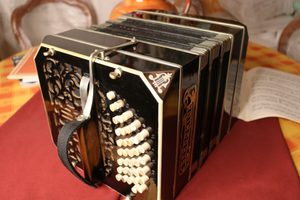
How Olivier Manoury Made the Chromatic Bandoneon’s Left Hand Symmetric
Olivier Manoury needs no introduction to anyone who has spent time with the chromatic — or unisonoric — bandoneon. Back in the 1920s, the French accordionist Charles Péguri devised a keyboard logic that broke with the old German Rheinische system: the same button gives the same note whether the bellows are opening or closing, and the notes themselves run in a simple chromatic sequence rather than the scattered, semi-random layout accordionists had struggled with for decades. Manoury later refined that system further — the “Manoury system” is now built into every new unisonoric “Peguri-like” bandoneon.
Recently I had the chance to record and publish a video with Olivier about his latest piece of work, and it’s one of those ideas that sounds almost obvious once you’ve seen it, and yet nobody had done it before: rebuilding the left keyboard of a chromatic Péguri so that it becomes a true mirror of the right one.
An asymmetry hidden in plain sight
Here is the detail that most players simply live with, without ever questioning it. Even on a fully chromatic, unisonoric instrument — where the musical logic is identical on both hands — the physical geometry never was. The distances between adjacent buttons, and the angles at which the rows fan out under the fingers, have traditionally been different on the left keyboard than on the right. Two hands, one system, two different physical grids to memorize.
It’s the kind of inconsistency that tends to hurt the left hand hardest. That’s the side carrying the bass line, the chordal accompaniment, and often the widest stretches and fastest position changes — exactly where you’d want the most comfortable geometry, not the least. Players with smaller hands feel it even more acutely.
Olivier’s project takes that asymmetry and simply removes it: he redesigned the left keyboard so that every distance and every angle between the buttons matches the right keyboard exactly, button for button, like a mirror image.
Inside the mechanism
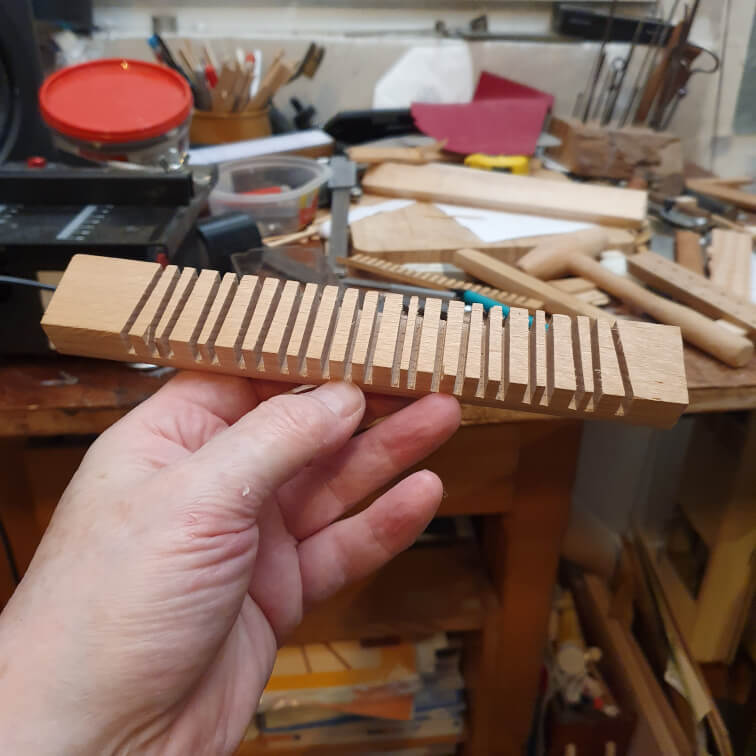
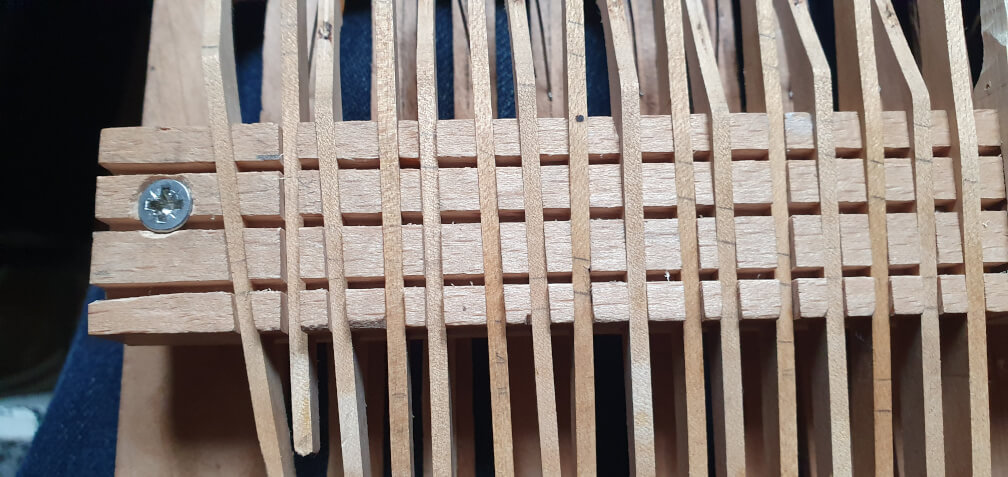
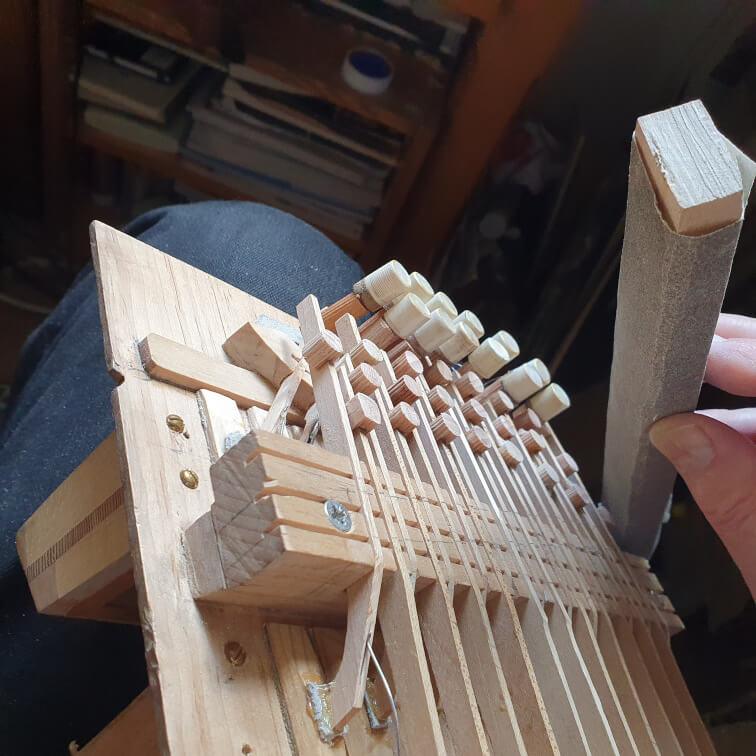
Saying it is one thing; building it is another. A bandoneon’s máquina — the mechanism packed inside each keyboard box — is a dense lattice of slender wooden levers, each one running from a single button, through a guide comb cut with dozens of narrow slots, down to its own felt-tipped pallet sealing a reed chamber. Everything has to stay airtight, responsive, and silent under the fingers, all within a wooden box a few centimeters deep.
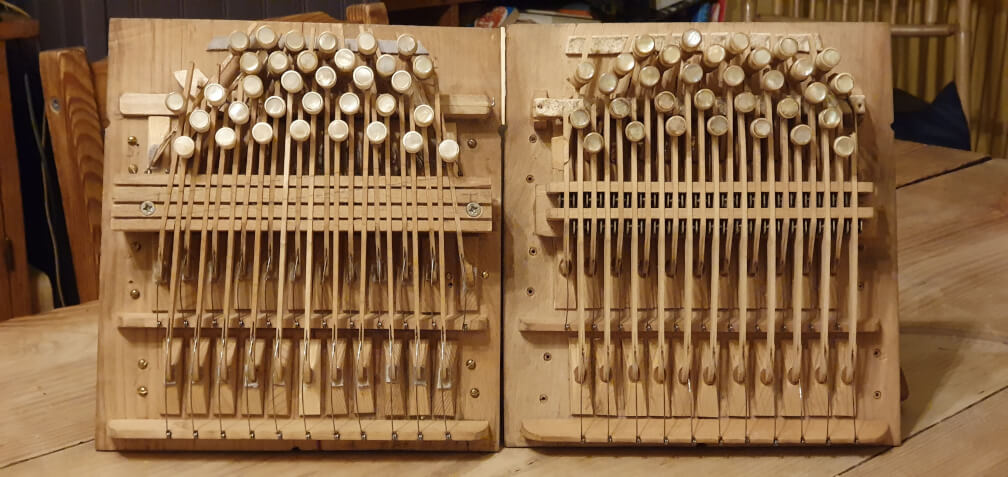
Shifting a keyboard’s geometry means shifting where every one of those levers has to land. In the photos from Olivier’s workbench you can see the guide comb on its own — row after row of narrow saw-cuts, each one positioning a single lever — and then the comb with the levers threaded through it, a woven-looking lattice of wood strips crossing the frame at just the angles the new layout demands. Every lever in that lattice had to be individually cut, fitted, and calibrated by hand so it would still reach precisely the right pallet after the whole keyboard shifted underneath it.
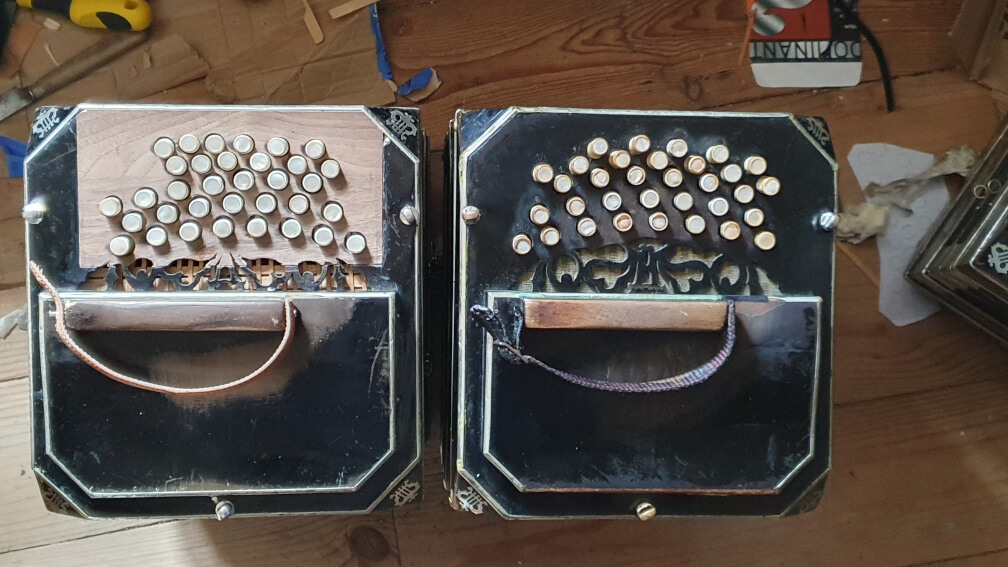
Seen assembled and closed up, the result doesn’t look like a modification at all — it looks like it was always meant to be this way. Both keyboard boards now show the same fan-shaped spread of mother-of-pearl buttons, at identical distances and angles; you can tell the left side is the rebuilt one mostly by the lighter, newer wood of its insert next to the aged wood around it.
What changes for the player
The immediate, practical payoff is comfort: wide chords and fast passages on the left hand stop fighting an unfamiliar geometry, because there no longer is one. Whatever a player’s hand has learned on the right side — reaches, angles, the physical shape of an interval under the fingers — now transfers directly to the left. That doesn’t change what the left hand plays, of course; it still lives mostly in the bass and accompaniment register. But it changes how much the hand has to relearn to get there, which matters a great deal for anyone starting the instrument, and probably most of all for players with smaller hands, for whom the old asymmetric spacing was hardest to reach around.
Where this could go next
This modification builds on ground Olivier had already broken with the Manoury system itself, but it’s a different kind of refinement — this time the note logic isn’t touched at all, only the physical geometry the hands have to navigate. A few questions from our conversation stayed with me afterward: whether this kind of rebuild could become standard on new instruments rather than a retrofit on existing ones; who besides Olivier has the specialized skill to carry out this kind of work, since it sits somewhere between bandoneon restoration and instrument design; and — more provocatively — whether the same idea could eventually be applied to the historic 142 Rheinische system, the traditional bisonoric tango bandoneon, where the challenge would be considerably bigger given how differently that keyboard is organized to begin with.
I’ll leave those questions for Olivier to answer in his own words — the full video is below, with him walking through the idea, the build, and what he thinks it could mean for how the chromatic bandoneon gets played and taught in the years ahead.